Breaking News



Popular News




Enter your email address below and subscribe to our newsletter
Clans Clashing Tips
 ByTrooper
Welcome to the battlefield, where your builders are always busy, your gold somehow disappears overnight, and one sneaky Wall Breaker can ruin your entire day. This blog post will use humor, relatable gamer moments, and practical in-game insights to uncover some of the most useful Clash of Clans secrets players often overlook.
In Clash of Clans, your base is not just a storage unit with anger issues. It is a mind game wrapped in walls, sprinkled with bombs, and guarded by defenses that take personal offense to every attacker who taps your village. The best layouts do not simply absorb damage. They manipulate enemy decisions, create bad troop pathing, and quietly whisper, “Go ahead, attack from that side. I dare you.”
A lot of players still build as if they are entering a village beauty pageant. Everything is neat, symmetrical, and polished enough to make an interior designer proud. Unfortunately, enemy troops do not hand out style points. They come to steal your loot, flatten your Town Hall, and leave you staring at the replay while pretending you “meant” to log off anyway. A strong base works because it creates confusion, wastes time, and punishes overconfidence.
A visually satisfying base often feels safe because it looks organized. The walls line up nicely, defenses are evenly spaced, and everything appears under control. But in practice, overly clean layouts can become predictable. Predictable bases are a gift to experienced attackers, because they can read the structure in seconds and decide exactly where to send their troops. If your base looks like it was designed with a ruler and a dream, chances are someone has already planned how to dismantle it before your Archer Tower even wakes up.
Strategic bases, on the other hand, are built to disrupt expectations. They may look awkward, uneven, or slightly suspicious, and that is exactly the point. A compartment in an unusual place, a gap that seems harmless, or a defense positioned just off-center can throw off troop pathing and make attackers hesitate. In Clash of Clans, hesitation is expensive. One second of uncertainty can mean a missed spell, a failed funnel, or a hero wandering around the outside of the base like he is out for a scenic jog.
For example, a perfectly symmetrical farming base may look solid from every angle, but symmetry often gives attackers too many easy entry options. Once they identify one weak point, they can usually assume the rest of the layout behaves the same way. Compare that to a deliberately irregular war base, where each side offers a different risk. One side may lead into Giant Bombs, another into high-damage defenses, and another into a compartment that wastes precious time. Suddenly, the attacker is not just raiding. They are solving a puzzle while your Inferno Tower judges them silently.
The smartest bases understand one glorious truth about Clash of Clans players: we are all a little greedy. See an exposed resource building or a section that looks under-defended, and many attackers immediately think they have found the easy route. That instinct is exactly what good layouts exploit. A base should not just defend. It should tempt.
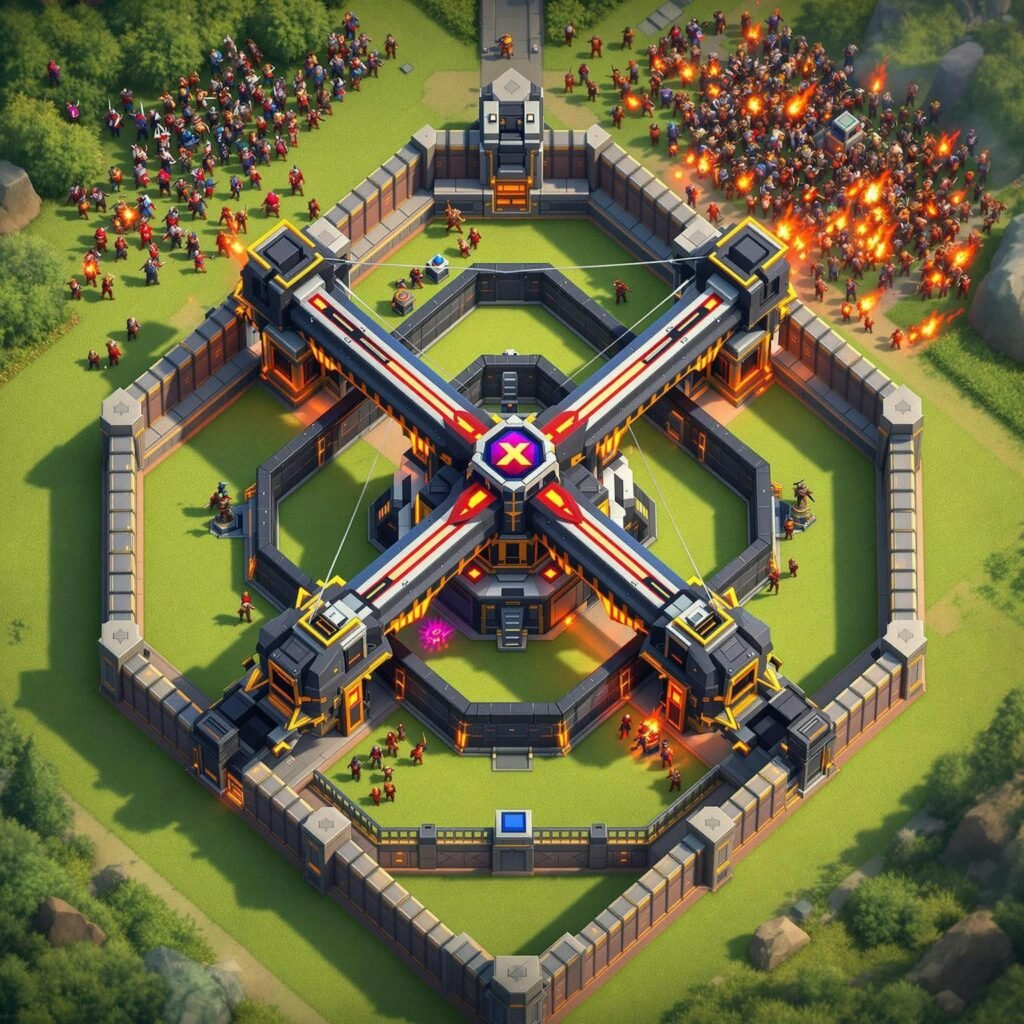
Intentional gaps, exposed buildings, and inviting entry points can all serve as bait. A seemingly weak outer layer may lure Wall Breakers into a bad path. A line of collectors can encourage funneling in a direction that leads straight into splash damage. Even the placement of traps can shape behavior. Spring Traps can punish predictable Hog Rider paths, Seeking Air Mines can ruin a Healer-supported push, and Giant Bombs can turn a confident ground attack into a support group meeting.
This is where base design becomes psychological warfare. You are not relying on raw defense levels alone. You are predicting what the attacker wants and turning that desire against them. If they want easy loot, give them a path that looks easy. If they love attacking from the side with the shortest wall distance, make that side a nightmare. If they always chase value with heroes and spells, place your key defenses where they force awkward timing decisions.
The best part is that when this works, the replay becomes comedy. You get to watch troops walk confidently into a trap you set hours earlier while you sit there feeling like an evil genius with a village full of trust issues.
Imagine a base where one side appears softer than the rest. A Gold Storage sits close to the outer wall. The compartments behind it seem lightly protected, and the attacker assumes they have found the jackpot. They drop Wall Breakers, open the layer, and send in a push expecting a smooth ride to the core.
What they do not realize is that this “easy” side is a carefully staged disaster. The first compartment is designed to pull troops inward at a bad angle. Hidden Tesla towers pop up. A Giant Bomb welcomes the support troops like an explosive handshake. The heroes drift off course because the funnel was never as clean as it looked. Meanwhile, high-value defenses in the core stay active longer because the attack has already lost momentum.
That is the difference between a base that merely exists and a base that thinks ahead. One waits to be attacked. The other sets a trap, smiles politely, and lets the attacker make all the wrong choices.
If you want stronger defenses in Clash of Clans, stop asking whether your base looks impressive. Start asking whether it makes attackers uncomfortable. Because the moment your layout starts influencing enemy behavior, you are no longer just building a village. You are building a panic machine.