
Jump to section
Introduction
Search for a “Fire Wizard” in Clash of Clans and you will find plenty of pages happy to sell you one. Almost all of them share two problems: they promise exact stats and never give you a number, and they lean on “hacks” language that reads like filler rather than tactics. This guide does the opposite. It gives you the real numbers behind the game’s most misunderstood fire troop, explains the splash mechanic that actually decides fights, and shows where the fire-damage units fit in a working army.
One thing needs saying up front, because it changes how you read every other guide on this topic. There is no troop called the “Fire Wizard” in the Home Village. Clash of Clans has the Wizard, its boosted version the Super Wizard, and — in Builder Base only — the Electrofire Wizard. The “fire” part of the name comes from the Wizard’s attack visual and from years of community shorthand. That is not a technicality to argue about; it is the reason so many Fire Wizard pages feel hollow. There are no invented stats to memorise, only real mechanics to understand.
Get those mechanics right and the payoff is large. Wizards are the cheapest reliable splash damage in the game, they hit both ground and air, and they are the single most common reason a funnel holds together instead of collapsing. Get them wrong and you watch four of them die to one Wizard Tower before the tank has walked ten tiles.
Key takeaways
- No “Fire Wizard” troop exists in Home Village. The fire-damage units are the Wizard (4 housing, 3-tile range, 0.3-tile splash) and the Super Wizard (Dark Elixir boost, chain lightning).
- The splash radius is 0.3 tiles — small, not large. Wizards punish tight clusters, not spread bases. This is the correction most guides get wrong.
- Wizards hit air and ground, which is why they double as defence against Clan Castle balloons and dragons.
- The Super Wizard chains damage to connected targets, but it is a precision tool that needs spell support, not a straight upgrade.
- Lab priority matters more than level chasing. Wizard upgrades are cheap in elixir and pay off in every war comp that uses them.
- Fragility is the whole risk. Wizards have a modest health pool; without a tank in front, splash damage deletes them.
What “Fire Wizard” actually means in Clash of Clans
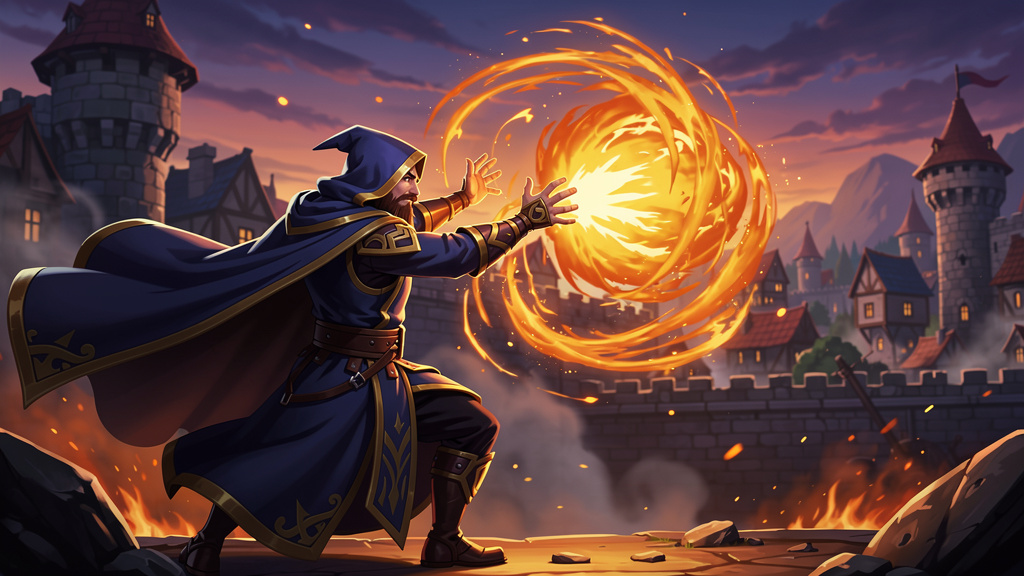
Featured image. Alt text: “Blue-robed Clash of Clans Wizard casting a fireball at a stone village at dusk.” Caption: “The ‘Fire Wizard’ players search for is the standard Wizard — same troop, same fire, different nickname.”
The naming confusion is worth two minutes because it decides whether you build the right army. Three units get called “fire” in casual conversation, and only one of them is available in your Home Village barracks.
The three fire-damage units
The Wizard is the baseline. An elixir troop unlocked at Barracks level 7, costing 4 housing space, with a 3-tile range and a 1.5-second attack interval. It throws a fireball that splashes in a 0.3-tile radius and — this is the part people forget — it targets air as well as ground. A pack of Wizards is genuinely one of the better answers to an incoming Lava Hound or a Clan Castle dragon.
The Super Wizard is the boosted variant. You unlock the boost by reaching Wizard level 9, and it costs 25,000 Dark Elixir for a three-day boost window. Its fireball becomes a chain-lightning bolt that arcs from the initial target to further connected targets. That sounds strictly better. It is not. The chain only fires when defences are connected, so on spread bases you have paid Dark Elixir for a slower, more expensive Wizard.
The Electrofire Wizard lives in Builder Base, unlocked at Builder Hall 10. It is the only unit in the game with “fire” literally in its name, it uses a fire-and-electro attack, and it is a situational pick — strong into bases built around high-hitpoint structures like storages and the Builder Hall, weak against fast, spread layouts.
If you have been searching for Fire Wizard stats and found nothing concrete, that is why. The troop does not exist under that name. What exists is a very good splash troop with three different identities depending on which village you are attacking.
Verified Wizard stats
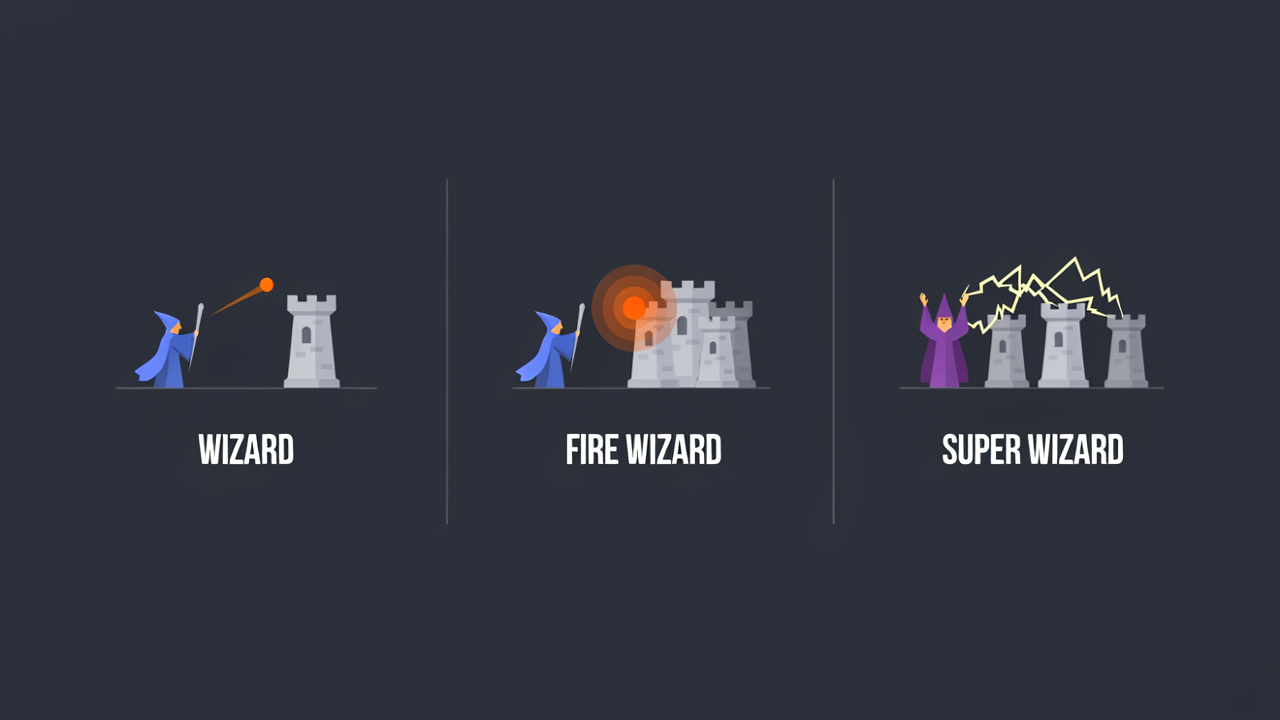
In-article image 1. Alt text: “Infographic comparing Wizard, Fire Wizard and Super Wizard attack profiles in Clash of Clans.” Caption: “Single-target burst, tight splash, chain lightning — the three profiles behave very differently on defence-heavy bases.”
These are the structural numbers that do not change with level. Damage per second and hitpoints scale with each upgrade, so treat the values below as the shape of the troop rather than a snapshot of one level.
| Stat | Wizard | Super Wizard | Electrofire Wizard |
|---|---|---|---|
| Village | Home Village | Home Village | Builder Base |
| Housing space | 4 | 4 (boosted) | Varies by level |
| Attack range | 3 tiles | 3 tiles | Short–moderate |
| Attack speed | 1.5s | 1.5s | Slower, heavier hit |
| Splash radius | 0.3 tiles | Chains within ~4 tiles | Small fire area |
| Targets | Ground and air | Ground and air | Ground and air |
| Cost to run | Elixir | 25,000 Dark Elixir boost | Builder Base army |
| Unlock | Barracks level 7 | Wizard level 9 | Builder Hall 10 |
Two rows carry most of the strategic weight. The 0.3-tile splash means a Wizard’s fireball barely reaches past the building it is aimed at — it is not an area-denial weapon, it is a cluster-punisher. And air targeting means a Wizard pack is never wasted army space, even against a layout with no ground troops in the Clan Castle.
Core mechanics that decide fights
Splash punishes clustering, not spread
The single most useful correction to make: the Wizard’s splash is tight. A 0.3-tile radius covers a building and its immediate neighbours, which is exactly why Wizards are devastating against compact cores and underwhelming against open rings. On a base where defences sit shoulder to shoulder — Inferno Towers, X-Bows and Wizard Towers packed into one compartment — six Wizards under Rage will clear that compartment faster than almost any other 24 housing space in the game. On a base where every defence has two tiles of air around it, the same six Wizards spend their fire on single buildings and die doing it.
This is why “Fire Wizard” advice that talks about “lingering thermal destruction across the base” is misleading. The destruction is real, but it is local. Your job as the attacker is to make the enemy base local too.
Funnel first, deploy second
Wizards are the cheapest funnel in Clash of Clans, and funnelling is the reason they exist in competitive armies. The pattern is consistent across Town Hall levels:
- Send two to four Wizards down one edge to clear trash buildings and pull the defence attention outward.
- Send the same down the opposite edge.
- Drop the main push — Golem, Ice Golem, Queen Walk, Root Rider, whatever your comp is — once both edges are clear.
Without step one and two, your tank walks into the middle of the base and the Wizards follow it into a crossfire. With them, the tank walks a corridor and the Wizards walk behind it hitting defences that cannot shoot back.
Fragility is the cost of the damage
Wizards have a modest hitpoint pool and no damage reduction. A single Wizard Tower volley, a Mortar hit or a well-placed Giant Bomb removes a whole group. Three rules keep them alive:
- Never lead with Wizards. A tank must be taking fire before the first Wizard lands.
- Spread the drop, not the group. Deploy Wizards in a loose line so one splash hit cannot kill four at once.
- Watch for traps in the funnel path. Wizard deaths in war are usually trap deaths, not defence deaths.
Spell support is what turns good into great
Rage is the standard pairing and the one most players already use. Two less obvious pairings matter more at high Town Halls:
Rage timing beats Rage placement. Drop Rage so the Wizards are inside it as they reach the core, not as they walk toward it. A Rage cast on the approach is a wasted spell.
Invisibility covers the reload. Wizards have a 1.5-second attack interval; that pause is when they die. An Invisibility Spell dropped on the pack as the tank dies buys the second volley that finishes the compartment.
How to use Wizards in real attacks
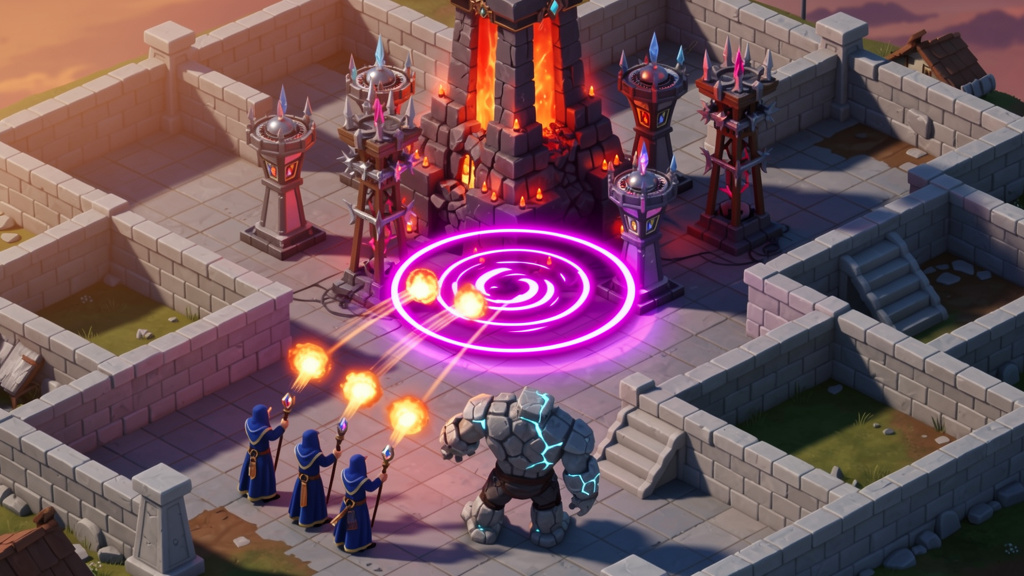
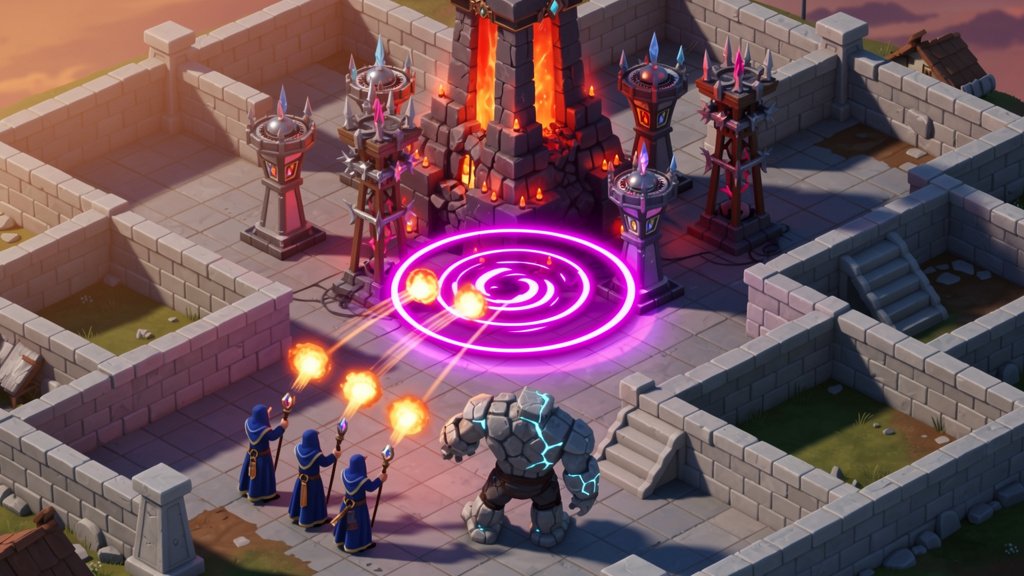
In-article image 2. Alt text: “Isometric Clash of Clans base showing Wizards firing into clustered defences behind a Golem tank under a Rage Spell.” Caption: “Tank in front, Wizards behind, Rage on the core — the arrangement that turns 24 housing space into a compartment clear.”
War attacks: the standard fire-support role
In war, Wizards are almost never the star. They are the multiplier. A typical Town Hall 11 to 13 ground push runs eight to twelve Wizards behind two Golems or an Ice Golem, with the Queen handling one edge and the Wizards handling the other. Their job is to convert a tank’s surviving hitpoints into base progress: while the Golem absorbs Inferno Tower fire, the Wizards remove the Inferno Tower.
Farming: cheap, fast, replaceable
For farming, Wizards are a poor primary troop — too fragile, too slow to train in bulk. They work as a supplement: four to six behind Giants or Barbarians to punch through a storage compartment, or as the cleanup wave after a Barch raid has taken the outer ring. Elixir cost is low enough that losing them is not a real loss.
Trophy pushing: the funnel that protects the push
Above Crystal League, the value of Wizards is almost entirely defensive-trap avoidance. A well-timed two-Wizard funnel on each edge removes the trash buildings that would otherwise pull your Bowlers or Balloons off course, and it costs eight housing space to do it. Compare that with the cost of a failed push, and the maths is obvious.
Clan Castle defence
This is the most underrated use. Wizards in your defensive Clan Castle hit air and ground with splash, which makes them one of the best all-round defensive fills in the game. A pack of Wizards behind a Valkyrie or Dragon will shred a Balloon drop or a Minion swarm before it reaches the core.
Upgrades and lab priority
The Wizard’s lab upgrades are among the best value in the game for one simple reason: they are elixir-cheap, and the troop appears in more war compositions than any other four-housing unit. A rough priority order for most players:
- Wizard to max for your Town Hall first. Every level is a direct damage increase on a troop you already deploy in every war.
- Wizard Tower on defence next. Your own base is attacked by the same troop you use; the tower that counters it should not lag.
- Super Wizard boost only when the base suits it. Pay the 25,000 Dark Elixir when you are hitting a compact, defence-dense layout — not as a default.
- Electrofire Wizard only if you actively push Builder Base. It is a situational Builder Hall 10 pick, not a priority unlock.
The trap most players fall into is treating the Super Wizard as the end state. It is a specialist. On spread layouts the standard Wizard at a high level outperforms it for a quarter of the cost, because the chain has nothing to chain to.
Common mistakes that waste Wizards
- Deploying into a Wizard Tower’s arc. The tower outranges the troop; Wizards walk in and die before their first volley.
- Treating 0.3-tile splash as area denial. It is not. If defences are spread, Wizards are single-target troops with extra steps.
- Clumping the drop. One Mortar shell or Giant Bomb removes the whole group.
- Raging the approach instead of the core. The spell’s value is in the damage window, not the walk.
- Boosting to Super Wizard on open bases. You pay Dark Elixir for a chain that never fires.
- Skipping the funnel. Wizards thrown in behind a tank without edge clearing just add bodies to the crossfire.
FAQ
Is there a Fire Wizard in Clash of Clans?
No. The Home Village has the Wizard and the Super Wizard. The only unit with “fire” in its name is the Electrofire Wizard, which is Builder Base only. “Fire Wizard” is community shorthand for the standard Wizard’s fireball attack.
How much housing space does a Wizard take?
Four. That makes a pack of six Wizards 24 housing — cheap enough to use as a funnel in almost any composition.
Do Wizards hit air troops?
Yes. Wizards deal area splash damage to both ground and air targets, which is why they are a strong Clan Castle defensive fill against Balloon and dragon attacks.
What is the Wizard’s splash radius?
0.3 tiles. It is deliberately tight — Wizards punish clustered defences and struggle against spread layouts. This is the key mechanic most guides get wrong.
Is the Super Wizard better than the Wizard?
Only on compact bases. The Super Wizard’s chain lightning needs connected targets to be worth its 25,000 Dark Elixir boost. Against spread layouts the standard Wizard is more cost-efficient.
What Town Hall should I max Wizards at?
Every one. The upgrade is elixir-cheap and the troop appears in more war armies than any other four-housing unit, so there is rarely a reason to let it lag behind your Town Hall.
The bottom line
The “Fire Wizard” is a nickname, not a troop — and once you stop hunting for stats that do not exist, the real mechanics are simple and unusually profitable. Four housing space, three tiles of range, 0.3 tiles of splash, air and ground targeting. The troop’s whole job is to turn a tight enemy core into rubble while a tank absorbs the return fire.
Build the funnel first. Tank before troop. Rage the core, not the walk. Boost to Super Wizard only when the base gives the chain something to hit. Do those four things and the fire damage stops being a visual effect and starts being the reason your war attacks three-star.
The Thursday War Brief
One email a week: the attack plan, the base link and the upgrade order that matters for your Town Hall. No gems, no spam.
Join chiefs getting the Thursday War Brief. Unsubscribe in one click.

TroopTacticsHub contributor

Leave a Reply